
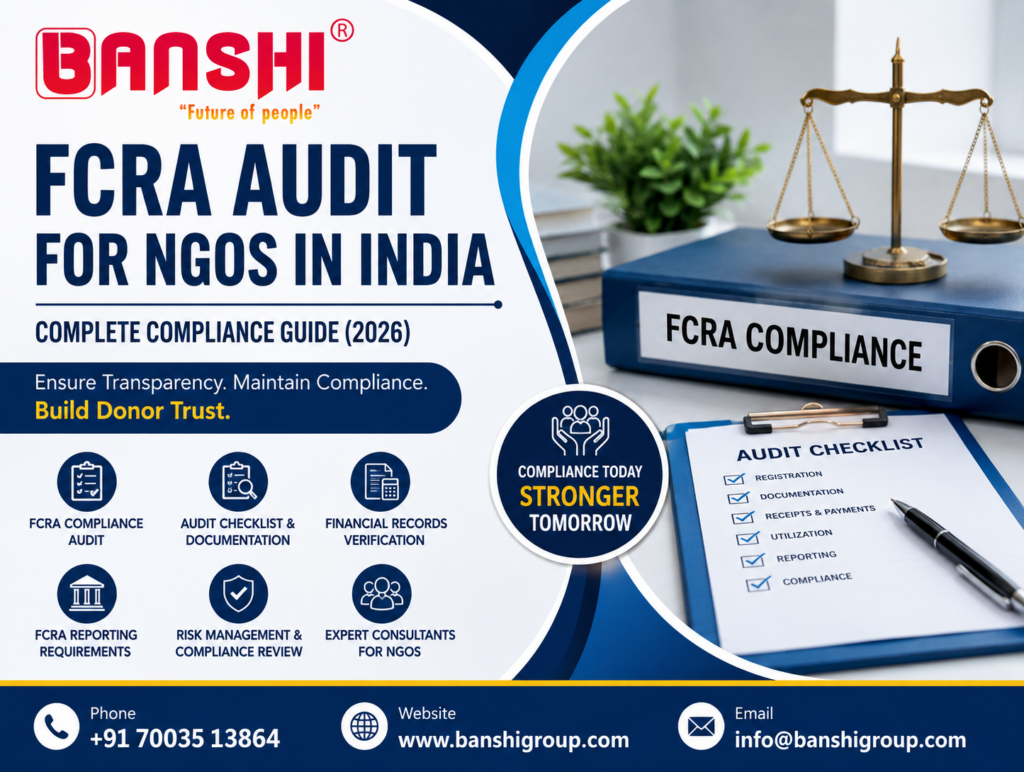
FCRA Audit for NGOs Introduction
Running an NGO is a little like being the captain of a ship. You have to keep your mission on course, satisfy donors, maintain transparent financial records, comply with government regulations, and somehow still find time to organize awareness campaigns. If foreign contributions are part of your organization’s funding, another important responsibility enters the picture—FCRA Audit for NGOs.
Many NGOs believe that receiving foreign donations is the difficult part. Surprisingly, maintaining proper records and complying with the Foreign Contribution (Regulation) Act (FCRA) often requires even greater attention. A well-planned FCRA compliance audit helps organizations demonstrate financial transparency, strengthen donor confidence, and ensure that statutory requirements are properly followed.
At Banshi Group of Companies, we regularly assist organizations in understanding legal documentation, financial compliance, and regulatory procedures. While every NGO has unique circumstances, maintaining accurate records and following applicable regulations can significantly reduce compliance risks.
Think of an FCRA audit as a routine health check-up. Nobody wakes up excited about a medical examination, but everyone appreciates discovering small issues before they become major problems. The same principle applies to NGO compliance. A systematic review today may prevent unnecessary complications tomorrow.
This comprehensive guide explains the FCRA audit process, FCRA audit checklist, FCRA reporting requirements, documentation practices, and practical compliance measures for NGOs operating in India.
What is FCRA Audit for NGOs?
One of the most frequently searched questions online is:
What is FCRA Audit for NGOs?
An FCRA audit is the examination of financial records, books of accounts, foreign contribution receipts, utilization records, and statutory documentation maintained by an organization registered or permitted under the Foreign Contribution (Regulation) Act.
Its primary objective is to verify whether:
- Foreign contributions have been received through the designated FCRA bank account.
- Funds have been utilized for approved objectives.
- Financial records are maintained properly.
- Reporting obligations have been fulfilled.
- Applicable provisions of the FCRA and related rules are being followed.
Unlike ordinary accounting reviews, an FCRA compliance audit specifically focuses on transactions involving foreign contributions and the statutory framework governing such funds.
Simply put, if your NGO receives overseas donations, your records should tell a clear story—not resemble a mystery novel where every chapter raises more questions than answers.
Is FCRA Audit Mandatory in India?
Another common question is:
Is FCRA Audit Mandatory in India?
Organizations receiving foreign contributions are required to comply with applicable provisions of the Foreign Contribution (Regulation) Act, related rules, and other relevant laws. Depending on the organization’s circumstances, financial reporting and audit obligations may arise under FCRA, applicable accounting standards, and other governing statutes.
Compliance requirements may vary depending on factors such as:
- Registration status
- Nature of activities
- Volume of foreign contribution
- Applicable legal provisions
- Annual reporting obligations
For this reason, NGOs are encouraged to maintain proper books of accounts and obtain professional guidance whenever necessary.
A practical way to think about it is this: compliance is far easier—and usually less expensive—than correcting mistakes after they are discovered.
Why NGO FCRA Compliance Matters More Than Ever
Foreign donors increasingly value transparency, governance, and accountability. Regulatory authorities also expect organizations to maintain complete documentation supporting every foreign contribution received and utilized.
Strong NGO FCRA compliance offers several advantages:
- Improves financial transparency.
- Builds confidence among donors.
- Supports effective internal financial management.
- Facilitates smoother statutory reporting.
- Helps identify documentation gaps.
- Encourages stronger governance practices.
- Reduces the likelihood of avoidable compliance issues.
Good compliance is like keeping your study notes organized throughout the semester. It saves countless hours when examinations—or audits—arrive.
How to Conduct FCRA Audit for NGOs in India
Many organizations search for How to conduct FCRA audit for NGOs in India because the process appears technical. Fortunately, when broken into stages, it becomes much easier to understand.
A typical FCRA audit procedure for registered NGOs involves several structured steps.
Step 1: Review FCRA Registration Details
The audit generally begins by reviewing the organization’s registration status, designated bank account information, registration validity, and related documentation.
Auditors may verify whether:
- Registration details are current.
- Designated bank accounts are properly maintained.
- Required approvals are available.
- Organizational records remain updated.
Starting with the basics prevents unnecessary confusion later.
Step 2: Verify Foreign Contribution Receipts
The next stage focuses on all foreign contributions received during the financial year.
This includes reviewing:
- Donor information
- Amount received
- Date of receipt
- Banking records
- Purpose of contribution
- Supporting documentation
Each receipt should be traceable through proper financial records.
Imagine trying to solve a puzzle with missing pieces. Even if only one receipt lacks documentation, the overall picture becomes harder to understand.
Step 3: Examine Utilization of Foreign Funds
One of the most important components of the Foreign Contribution Regulation Act audit is verifying how foreign funds have been used.
The review generally considers whether expenditures align with:
- Approved organizational objectives
- Available financial records
- Supporting invoices
- Accounting entries
- Internal approvals
Proper documentation plays a significant role in demonstrating transparent fund utilization.
Step 4: Verify Books of Accounts
Accurate accounting remains the backbone of every successful NGO.
During an NGO financial audit, professionals typically review:
- Cash book
- Ledger
- Bank book
- Journal entries
- Receipt records
- Payment vouchers
- Supporting invoices
Well-maintained records simplify the audit process considerably.
As accountants often joke, “Numbers rarely lie—but untidy spreadsheets occasionally create excellent fiction.”
Complete FCRA Compliance Checklist for NGOs
A structured Complete FCRA Compliance Checklist for NGOs helps organizations remain organized throughout the financial year instead of rushing just before reporting deadlines.
An effective checklist usually includes:
Registration Records
- FCRA registration certificate
- Governing body details
- Organizational resolutions
- Updated statutory records
Financial Records
- Cash book
- Ledger
- Trial balance
- Balance sheet
- Income and expenditure statement
- Bank reconciliation statements
Foreign Contribution Records
- Donor details
- Bank advice
- Utilization statements
- Project expenditure records
- Supporting vouchers
Administrative Records
- Meeting minutes
- Internal approvals
- Procurement documents
- Grant agreements
- Vendor invoices
Maintaining these records regularly is far easier than searching for misplaced documents months later. Every office seems to have that mysterious cupboard where missing files disappear—don’t let your compliance records end up there.
FCRA Audit Process Step by Step
Understanding the FCRA audit process step by step allows NGOs to prepare well before the audit begins.
A simplified workflow typically includes:
- Collection of statutory documents.
- Verification of registration details.
- Examination of foreign contribution receipts.
- Review of accounting records.
- Verification of expenditure.
- Reconciliation of bank accounts.
- Review of supporting documentation.
- Examination of statutory reporting.
- Identification of documentation gaps.
- Preparation of observations and recommendations.
The objective is not merely to identify errors but to strengthen compliance systems and improve financial governance for future reporting periods.
Organizations that maintain documentation throughout the year often experience a smoother audit process than those attempting to reconstruct records at the last minute. As every student knows, studying one chapter each week is much easier than trying to learn the entire syllabus the night before the exam—and compliance follows the same logic.
Documents Required for FCRA Audit
One of the most searched long-tail keywords is Documents Required for FCRA Audit. Maintaining complete and organized records not only supports compliance but also makes the audit process significantly smoother.
Typical documents required include:
Statutory Documents
- FCRA Registration Certificate or applicable approval
- Trust Deed, Society Registration Certificate, or Section 8 Company Incorporation documents
- PAN of the organization
- Governing body details
- Board or governing committee resolutions
- Registration renewal documents (where applicable)
Financial Documents
- Cash Book
- General Ledger
- Bank Book
- Trial Balance
- Balance Sheet
- Income & Expenditure Account
- Bank Statements of the designated FCRA account
- Bank Reconciliation Statements
Foreign Contribution Records
- Foreign donor details
- Grant agreements or sanction letters
- Foreign contribution receipts
- Utilization records
- Project-wise expenditure statements
- Supporting bills and invoices
- Payment vouchers
Compliance Documents
- Annual financial statements
- Audit reports
- FC-4 Annual Return and supporting schedules
- Correspondence relating to FCRA compliance (where relevant)
A practical tip: create digital folders by financial year and project. Your future self—and your auditor—will probably thank you.
FCRA Reporting Requirements
Understanding FCRA Reporting Requirements is essential for every organization receiving foreign contributions.
Organizations are generally expected to maintain accurate books of account and comply with applicable reporting obligations under the Foreign Contribution (Regulation) Act and related rules.
Common reporting responsibilities may include:
- Maintaining separate records for foreign contributions.
- Preserving supporting financial documents.
- Preparing annual financial statements.
- Filing applicable annual returns, including FC-4 where required.
- Recording designated bank account transactions accurately.
- Keeping utilization records project-wise whenever appropriate.
Accurate reporting reflects good governance and helps demonstrate transparency to stakeholders.
FCRA Annual Return Filing Process
Another frequently searched topic is the FCRA Annual Return Filing Process.
Annual reporting generally involves the preparation and submission of the prescribed return under applicable FCRA provisions.
The process commonly includes:
- Finalization of books of accounts.
- Preparation of financial statements.
- Verification of foreign contribution receipts.
- Compilation of utilization details.
- Review of supporting documentation.
- Preparation of the prescribed annual return.
- Internal verification before submission.
- Timely filing through the prescribed process.
Organizations should always refer to the latest requirements and deadlines issued by the competent authorities, as compliance procedures may change over time.
NGO Statutory Audit under FCRA
The phrase NGO Statutory Audit under FCRA often creates confusion.
A statutory audit examines an organization’s financial statements in accordance with applicable legal and accounting requirements. Where foreign contributions are involved, additional compliance checks may be necessary under the FCRA framework.
A well-conducted audit generally evaluates:
- Financial accuracy
- Internal controls
- Accounting records
- Documentation quality
- Compliance with applicable provisions
- Transparency in fund utilization
Rather than viewing an audit as an obstacle, many NGOs treat it as an opportunity to strengthen financial systems and governance practices.
Common FCRA Compliance Mistakes by NGOs
Even experienced organizations can make compliance mistakes. Fortunately, many are avoidable.
Some common FCRA Compliance Mistakes by NGOs include:
1. Incomplete Documentation
Missing invoices, payment vouchers, or donor records can make reconciliation difficult.
2. Poor Record Keeping
Waiting until the end of the financial year to organize accounts often leads to unnecessary stress.
3. Bank Reconciliation Delays
Regular reconciliation helps identify discrepancies early.
4. Weak Internal Controls
Clearly defined approval processes and segregation of responsibilities improve accountability.
5. Inconsistent Accounting Entries
Accounting records should accurately reflect supporting documents and bank transactions.
6. Delayed Compliance Activities
Completing compliance tasks well before deadlines reduces the risk of last-minute errors.
Think of compliance like brushing your teeth. Skipping it once may not seem serious, but neglecting it repeatedly usually results in a visit you would rather avoid.
FCRA Renewal and Audit Requirements
Organizations also search for FCRA Renewal and Audit Requirements.
Renewal requirements, documentation, and procedures are governed by the applicable provisions of the Foreign Contribution (Regulation) Act and related rules. NGOs should regularly monitor official notifications to stay informed about current requirements.
Before renewal, organizations are generally encouraged to review:
- Registration details
- Governing body information
- Financial statements
- Annual compliance records
- Audit observations
- Documentation completeness
Conducting an internal review before renewal can help identify areas that require attention.
Professional FCRA Audit Consultants in India
Many organizations seek Professional FCRA Audit Consultants in India to better understand compliance obligations.
Professional assistance may support NGOs in:
- Reviewing documentation
- Organizing financial records
- Understanding compliance procedures
- Strengthening internal controls
- Preparing for statutory reporting
- Improving governance practices
At Banshi Group of Companies, we assist organizations in understanding regulatory documentation, compliance procedures, and legal processes. Any course of action should be based on the facts of the individual case and applicable law.
Conclusion
An FCRA Audit for NGOs is much more than an annual compliance exercise. It reflects an organization’s commitment to transparency, accountability, and responsible financial management.
Maintaining proper documentation, following a structured FCRA Audit Checklist, understanding FCRA Reporting Requirements, and reviewing financial records regularly can make compliance significantly more manageable.
The best approach is not to wait until audit season. Build good record-keeping habits throughout the year, encourage internal accountability, and stay updated with official regulatory changes.
After all, compliance is a bit like maintaining an umbrella. It is much easier to carry it before it starts raining than to search for one during the storm.
If your organization is looking for guidance on documentation, compliance procedures, or understanding applicable legal requirements, Banshi Group of Companies provides structured assistance designed to help NGOs navigate regulatory responsibilities with greater confidence.
Contact Banshi Group of Companies
Need guidance on FCRA Audit for NGOs, FCRA Compliance Audit, NGO registration, statutory compliance, or legal documentation? Our team provides structured assistance to help organizations understand regulatory procedures and documentation requirements across India.
Banshi Group of Companies
📍 Office: First Floor, SDF Building, 211, Banshi, GP Block, Sector V, Bidhannagar, Kolkata, West Bengal 700091
📞 Phone: +91 70035 13864
🌐 Website: www.banshigroup.com
📧 Email: info@banshigroup.com
Our Services
- FCRA Compliance Guidance
- NGO Registration Assistance
- Trust Registration
- Society Registration
- Section 8 Company Registration
- NGO Annual Compliance
- Statutory Documentation Support
- Corporate Legal & Compliance Services
- Taxation & Regulatory Compliance
- Business Registration & Licensing
Schedule a Consultation
If you would like to understand the documentation, compliance procedures, or legal requirements applicable to your organization, contact Banshi Group of Companies for professional guidance. We provide structured assistance tailored to your organization’s compliance and documentation needs.
Frequently Asked Questions (FAQ)
1. What is FCRA Audit for NGOs?
An FCRA audit reviews foreign contribution receipts, utilization, accounting records, and compliance documentation maintained by eligible organizations under the Foreign Contribution (Regulation) Act.
2. Is FCRA Audit mandatory in India?
Organizations receiving foreign contributions should comply with applicable legal, accounting, and reporting requirements. Audit obligations depend on the applicable statutory framework.
3. Who can conduct an FCRA audit?
Audit and certification requirements should be carried out by professionals as required under applicable law. Organizations should consult qualified professionals regarding their specific obligations.
4. What documents are required for an FCRA audit?
Typical documents include registration certificates, books of accounts, bank statements, donor records, financial statements, supporting vouchers, and compliance records.
5. How often should NGOs review FCRA compliance?
Maintaining records throughout the year and conducting periodic internal reviews can help improve compliance readiness.
6. What is the FCRA audit checklist?
It generally includes registration records, financial books, designated bank account records, donor documentation, utilization records, statutory filings, and supporting vouchers.
7. What are FCRA reporting requirements?
Reporting requirements generally involve maintaining prescribed records, preparing financial statements, and filing applicable annual returns under the law.
8. What are common FCRA compliance mistakes?
Common issues include incomplete documentation, delayed record keeping, inconsistent accounting, weak internal controls, and late compliance activities.
9. Why is proper documentation important for NGOs?
Proper documentation improves transparency, simplifies audits, strengthens governance, and supports accurate financial reporting.
10. How can NGOs prepare for an FCRA audit?
Organizations can prepare by maintaining updated records, reconciling accounts regularly, preserving supporting documents, reviewing compliance periodically, and seeking professional guidance where appropriate.
Disclaimer
This article is intended solely for educational and informational purposes. It provides a general overview of the Foreign Contribution (Regulation) Act (FCRA) compliance and audit concepts and should not be interpreted as legal, financial, or professional advice. Laws, rules, notifications, and regulatory requirements may change over time. Organizations should refer to the latest official notifications issued by the competent authorities and obtain advice from qualified legal or financial professionals before making compliance decisions.